
This blog post is part of a series on effective graduate supervision that emphasizes the fifth principle of effective Scholarship of Teaching and Learning (SoTL): that “good SoTL practice involves ‘going public’” (Felten, 2013, p. 123). Aligned with this principle, Jennifer Lock, Tracy Byers Reid, and Michele Jacobsen collaborated on Dr. Lock’s supervision story to make this award-winning supervisor’s innovative mentoring practices visible and to share them as a community resource for supervisors across disciplines.
Jennifer Lock
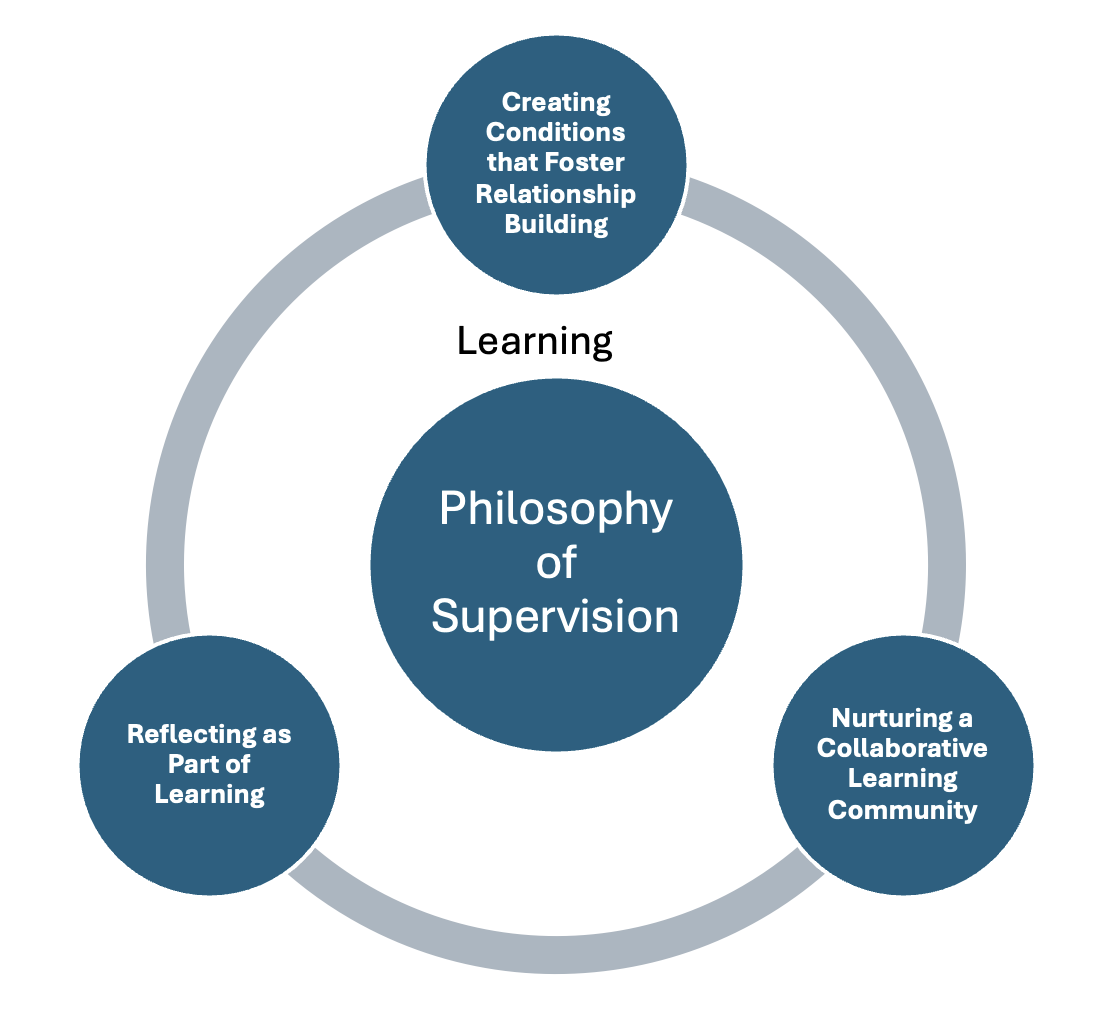
I created this graphic to visually represent my philosophy of supervision, which is grounded in three key principles: (1) creating conditions that foster relationship building, (2) nurturing a collaborative learning community, and (3) including reflection as part of learning. As supervisors, we build connections by cultivating a sense of community, one that encourages open communication, dialogue, discourse, and trust through collaboration. Reflection is woven throughout this process and supports learning at every stage.
I am deeply passionate about learning, and I want my students to share in that engagement. Learning is a process, and we learn from our interactions, our work, and our willingness to reflect thoughtfully on our practice. These three key principles anchor my approach to supervision, and the inner circle of the image represents the continuous learning that shapes us as supervisors.
Looking Back and Lessons Learned
Reflecting on my experience as a new supervisor, I learned the most from my colleagues. I spent time with them discussing their practices, listening to what worked for them, and then applying strategies and practices that made sense for me. Learning by observation was also important, whether by serving as a neutral chair or participating in supervisory or examination committees, as these provided another opportunity to learn from them and listen to my peers’ experiences.
I think learning collaboratively from others is a key component for new supervisors, like having the opportunity to co-supervise with a colleague for at least one student. New supervisors need time to learn the processes, practices, and expectations of what’s involved in their role.
Actions for Effective Supervision
To set themselves up for effective supervision, new supervisors should (1) serve on supervisory committees, (2) consult literature on supervisor best practices, and (3) reflect on their experiences being supervised and becoming a supervisor.
Serving on supervisory committees is a valuable experience for developing a support network and learning how to offer effective feedback to students. I think new supervisors should also be informed about supervision practices by reading literature about successful supervision experiences and relationships, and then assessing how it aligns with their philosophy and approach to supervision. Lastly, new supervisors should reflect on their experiences, both their previous ones as students as well as their current ones as supervisors. They should consider: What worked well and why? What might have been less successful? How could they improve? What are some strategies to enhance what occurred in that experience? For me, reflection plays a really key role in learning.
The first principle for me is building healthy, successful, and dynamic relationships, not only for the moment, but also considering their sustainability over time. A supervisor plays an essential role in inspiring, encouraging, and motivating students. You must consider how to help students achieve their goals in a way that invites them into the work, rather than you determining the direction; it’s more about sustained and respectful collegial discourse. Developing clear communication is essential for building strong relationships, including being proactive and providing many opportunities for conversation. I think it’s really critical for students who are at a distance because if you don’t hear from them, you need to determine the reason. Sometimes it’s important to be proactive and create opportunities to meet to ensure they feel comfortable. Frequent communication is essential to foster ongoing conversations. During my conversations with students, I might ask them about their work, ideas, or future goals, but supervisors must also listen carefully and be attentive to what the students are saying. Conversation also means effective listening to really consider how to help and support your students based on the nature of the support they need and their future goals. Understanding this context will help supervisors shape and adjust the research that students do.
Another component of relationship building is clearly sharing my supervisory process. I inform new and prospective students of my expectations for them and what they can expect from me. I think that’s really critical. As a supervisor, I have expectations of students, but what expectations do they have of me, and how do I meet those expectations? Discussing these expectations helps establish presence. Being available and visible to students, ensuring they receive timely feedback, and striving for clear communication. I always discuss next steps, especially at the end of a meeting, to create a sense that we’re continually improving this work; it’s not just one and done, but instead a process of constantly moving forward.
Knowledge for Effective Supervision
The first piece of advice I’d give new supervisors is to familiarise themselves with the processes and procedures for each degree that they’re supervising. This knowledge is so critical because if they come from a different institution, they might have that process as their frame of reference. Knowing what those processes and procedures are and how to find more information is necessary for answering student questions. They also need to stay current with those procedures, policies, and practices to ensure that students receive accurate information.
The second piece of advice is to think critically about how, as a supervisor, you will create the conditions for fostering relationship building. Consider what you want this to look like over time, and how to create conditions where students feel they can trust you when things are going sideways, knowing you’ll give them good advice. Building rapport and trust as a supervisor takes time.
My third piece of advice is to reflect on your practice. I think that’s so important for new supervisors, whether it’s after big milestones or after a meeting, really thinking about, “did that go well?” Supervisors are committed and dedicated to helping their students move forward. Reflecting on our practice and processes helps us to always think about what we can do to keep things moving forward.
One strategy I use is meeting regularly with the students and giving them space to discuss their work or themselves in relation to the work. When we have ongoing meetings, I get a pulse for when they start feeling stressed, worried, or overwhelmed. Recognising this provides moments that you can say, “Okay, let’s talk about our planning. Let’s think about how that would work out.” It’s important to make students aware of and invite them into opportunities, so they feel like they’re part of something bigger than their dissertation. Maybe they’ll become part of a research group or do a presentation at a conference. Inviting them into diverse opportunities helps students to feel connected and creates a sense of community.
Supervisors also need to let students know about planning for timelines and options if they can’t fulfil that timeline. I use backwards design with my students when we think about heading towards candidacy, which allows students to understand how many weeks in advance they need to plan. Thinking in these terms helps them to map that into their lives and the work they’re doing. Then we determine if this plan will work, and if not, how we need to adjust or be more flexible, always discussing timelines in really realistic ways. Getting to know your students well allows you to recognise when things start going sideways, so you can advise them. Because of extenuating life circumstances, they might need a leave of absence or extensions. Knowing the process and policies well allows you to discuss options with your students that might help them in their journey.
Innovation and Reflection
I have two innovative strategies to share, but my first one doesn’t always work; it depends on the students. I do group meetings for students who are in the same program if they’re within a year of each other. Often, if you have students in the same year of a program, they usually have the same kinds of questions. Group meetings create an interesting dynamic where the students can ask questions, share their work, and the meeting develops into their own support network. This group approach becomes beneficial for conducting mock exams before their final exam. They’ve got their colleagues, their people who have been on this journey with them, and can help be part of their mock exam. They also become their cheering team and each other’s sounding board because sometimes they don’t develop the same kind of cohesion with the students in their courses. It depends on personalities, and some personalities might not work in some groups. I found that this approach will work for a couple of years, and then it might not work with another group. I always tested it out to see how the students work as a group. They’re always welcome to meet with me individually as well. At some point in this journey, we often have individual meetings in addition to the group meeting.
My other strategy is involving students in a group research project that creates opportunities for them to lead and help make some of the decisions. These projects give them research experience in a supported way and provide new collaboration opportunities. These group research projects create a safe environment in the sense that we work more as a team, as opposed to dividing tasks. It gives them exposure and experience with research before they actually have to do their own research project. They can reflect on the group research process as they move forward independently.
I continually reflect on my practice around what makes for that quality supervision, thinking about it as a practitioner. I consider supervision in terms of the planning, the mentorship, the nature of the interactions, the assessment, and continually exploring what worked well and what needs to be done more effectively. I’m continually exploring how to improve my work as a supervisor; it is a project that is never done! It also involves engaging with colleagues around the work. I think having conversations with colleagues around different components of supervision is really informative, because it introduces ideas I hadn’t considered. I may not know if their strategy would work for me, but I might like this gem within that idea. You’re always searching for those valuable strategies.
I always reflect after big milestones, like candidacy or a final exam, places where there might be some learning that I can take away for the next person I supervise. I’m a reflective practitioner, thinking about my supervision practice to determine how I can continue to become better at supporting my students.
Learn More about:
Dr. Jennifer Lock, Professor, Werklund School of Education, University of Calgary [Profile]
Recipient, 2019 Izaak Walton Killam Graduate Supervision & Mentorship Award, University of Calgary
Recipient, 2018 Excellence in Supervision Award, University of Calgary Graduate Student Association (GSA)
Recipient, 2017 GREAT Supervisor Award, Faculty of Graduate Studies, University of Calgary
Recipient, 2014 Distinguished Graduate Supervision Award, Werklund School of Education
This Supervision Blog is part of Dr. Michele Jacobsen’s Research website.
